
First of all you should realize that the way the Sachs engine is designed, it is impossible to have shifting or jumping-out-of-gear problems. But, since this appears to be happening to many club members, we should look at the possible causes:
Jumping out of gear can be caused by 4 different conditions:
- Improper shifting
- Neutral select cable mis-adjustment
- Worn gears
- Shaft end-play
Each of these items will be discussed but first we should understand how the transmission operates. The shifting lever on the transmission operates a ratchet that positions the gears for different speeds. The engine drives the layshaft which has a 1st and 4th gear at each end that is firmly connected to the layshaft.
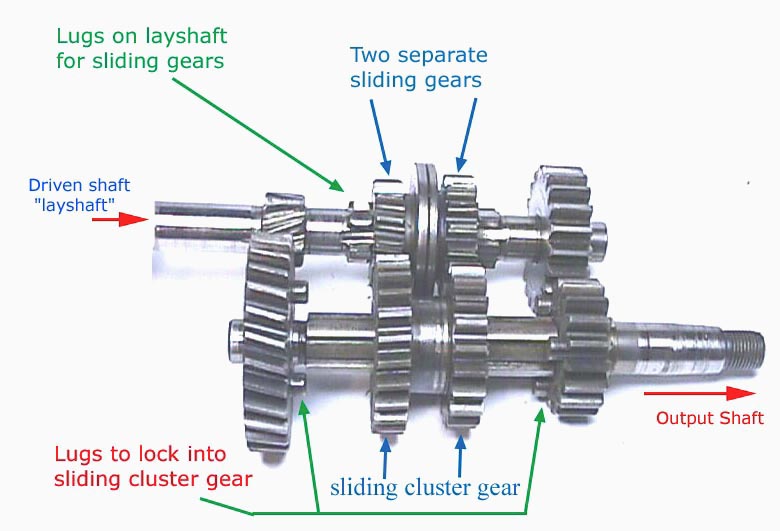
In the centre are 2 separate sliding gears (2nd & 3rd gear) that are driven by the layshaft when they are positioned over lugs on the layshaft. The output shaft is ‘splined’ and has a sliding cluster gear which is continually meshed with the sliding gears on the layshaft. All these sliding gears are moved laterally as a group when the transmission is shifted. There are holes in the side of the sliding cluster gear that ‘lock onto’ lugs of the end gears of the output shaft when in 1st and 3rd gear.
First Gear
The gears are shown in the 1st or low gear position. Gear 1 is a machined part of the layshaft. It meshes with gear 2 which is free to rotate on the output shaft. Gears 2and 3 are ‘locked’ together by lugs on gear 2. Gear 3 turns the ‘splined’ output shaft.
In 2nd gear, the loose sliding gear 1 is driven by ‘dogs’ on the layshaft. This in turn drives gear 2 of the cluster gear which in turn drives the output shaft.
In 3rd gear, the other loose gear 1on the layshaft is driven by a different set of dogs on the layshaft. This gear drives cluster gear 2 which in turn drives the output shaft 3.
The large gear 2 is ‘pressed’ onto the layshaft and is permanently connected. This drives loose gear 3 which has locking lugs that fit into cluster gear 4.
A shaft from the shifting arm connects to the ratchet assembly. The top of the ratchet assembly moves the selector fork to the different gear positions and the pawl holds the fork in place. The neutral selector is used to force the pawl out of the selector fork and allow the gears to go to a neutral position. An inexpensive new pawl spring will help hold the pawl in the selector fork notch. Using a stronger spring is not necessary and would only make it harder to shift gears.
Getting into gear
A shaft from the shifting arm connects to the ratchet assembly. The top of the ratchet assembly moves the selector fork to the different gear positions and the pawl holds the fork in place. The neutral selector is used to force the pawl out of the selector fork and allow the gears to go to a neutral position. An inexpensive new pawl spring will help hold the pawl in the selector fork notch. Using a stronger spring is not necessary and would only make it harder to shift gears.
The sliding gears for 2nd and 3rd gear have been positioned over the dogs on the layshaft by the selector fork. If spacers have been added or removed under the layshaft 1st gear, it may be necessary to add or remove eccentric washers at the neutral selector assembly to get the proper clearances between the loose sliding gears and the dogs on the layshaft when in neutral. When the gears are positioned in 4th gear, the sliding cluster gear is positioned by the selector fork and should lock-in to the 4th driveshaft gear as much as possible.
The sliding cluster gear should not be touching the 4th layshaft gear.
The overall layshaft distance should should be less than the space between the crankcase halveswhen everything is bolted together with the proper thickness crankcase gasket.
Endplay for the layshaft should be:
.05mm—.10mm (.002″—.004″)
and for the output shaft:
.10mm—.20mm (.004″—.008″)
If there is any ‘binding’ of the layshaft, it may be necessary to have the layshaft 4th gear pressed further onto the shaft and start all over.
Neutral Selector Adjustment
Neutral selector operation is quite simple. Pulling on the cable rotates the selector and forces the pawl out of the selector fork. It has a return spring. The other spring is only used to keep the cable end captured.
When properly adjusted, with the engine in gear, you will hear a ‘click’ back at the engine when the finger lever is squeezed. You can also check the amount of movement of the finger lever after you hear the click to insure that it is not just on the edge of releasing.
Worn Gears
The sliding gears on the layshaft become worn and are mostly responsible for jumping out of 2nd and 3rd gear problems. The ‘dogs’ on the layshaft fit into the sliding gears and they also become worn. The photos show worn layshaft dogs and a badly worn sliding gear. This wear can cause the sliding gear to move laterally and jump out of gear.
With gears like this it is understandable why the selector fork can’t hold the gears in position under heavy loads.
Final Word on Gear Problems
If you have problems with grinding gears when shifting or jumping out of gear, FIX IT NOW! The problem will only get worse until the gears are totally destroyed and it is almost impossible to replace them.
Another problem is getting spacers (washers, shims) for the shafts to get the proper end-play. I have never found a source for these spacers and had to make them by hand which is no easy task. If the shafts have too much end-play, continual lateral vibration can cause the gears to ‘walk’ out of position.
I would also suggest that anyone working on the engine get publications from Partsmart.
These are:
1805 Sachs parts list
1806 KR200 workshop manual
1807 Engine manual
