Battery Selection & Fuse Protection
The following article from David Garner focuses on the batteries used by he different Messerschmitt models and provide information about the size, type and further technical explanation.
Read More

 admin
admin The following article from David Garner focuses on the batteries used by he different Messerschmitt models and provide information about the size, type and further technical explanation.
Read More
Since the invention of the internal combustion engine the movement of crankshaft, connecting rod, and piston have been at the heart of engine function right up to the present day. The following article provides technical information on the measurement of pistons for re-bore.
Read More
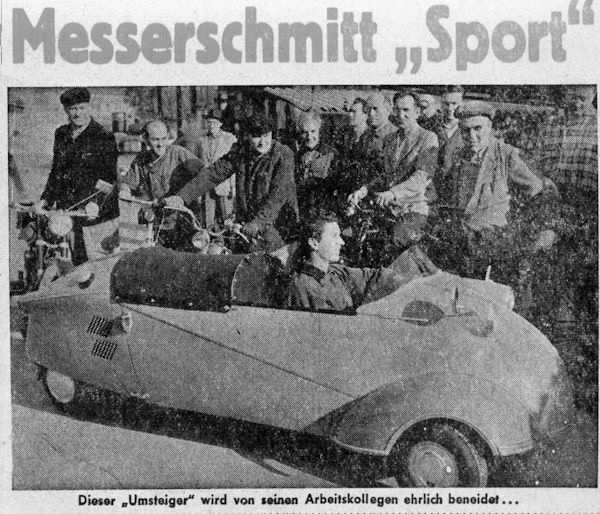
This has a small, aircraft style plexiglass windscreen and only two or three genuine examples exist. It was somewhat cheaper than the KR200 limousine as the expensive to manufacture aluminium top frame and perspex dome were omitted. It was made in limited numbers and probably to special order with the obvious disadvantage of no weather … Read more
Read More
This wiring diagram is for guidance only – you are strongly recommended to add a 20 ampere in-line fuse in the red cable at the rear bulkhead because there are unprotected circuits that may cause damage in case of short circuits. Any new wiring installation should be verified by a professionally qualified vehicle technician.
Read More

During World War 2, and particularly on the Russian Front, German field hospitals used limb amputations to avoid the risk of infection for seriously injured military personnel. This resulted in thousands of amputees who needed help after the war. Fend received valuable support from the American occupying forces to develop various vehicles to help these … Read more
Read More

The Messerschmitt 200 Super established 25 Long Distance and Period World Records at the Hockenheim Circuit on 29th-30th August 1955. The original car can be seen at the Deutsches Museum, Munich although not with the record breaking engine – the original engine was lost while in storage at F&S Schweinfurt. Normal two stroke tuning was … Read more
Read More
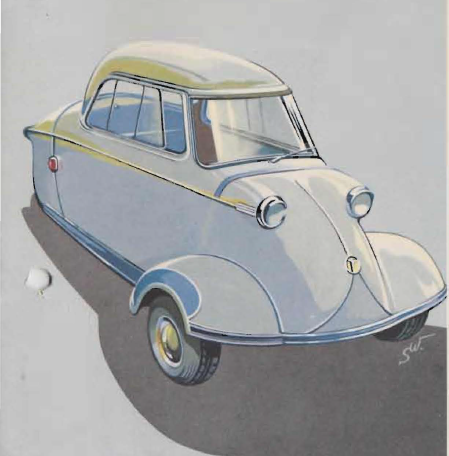
This brochure was published by RSM in 1956 and is probably the first brochure in English for worldwide use.
Read More

3 brochures – 1 English (2 sides) and 2 German (one blue & one red).
Read More

This road test has many tips for those new to Messerschmitt driving and highlights why it is the best of the microcars! The test car is interesting as it is one of the early FMR built cars. Note the ‘circles’ badge but with the RSM ‘whisker’ style front trim.
Read More
When Messerschmitt cars were sold new the manufacturer recommended that the petrol to oil ratio to use should be 25:1. The original phosphor bronze bush used with the aluminium conrod required such a ratio. With most cars having had their engines rebuilt using a steel con rod and a needle roller small end bearing, the … Read more
Read More

Body: steel tubular frame with steel panels Engine: 494cc FMR air cooled two stroke twin cylinders 19.9 HP Gears: 4 81mph Approximately 300 produced. With demand for more conventional cars increasing, Fend aimed to address this with the development of the four wheeled TG500. As FMR had taken over production from Messerschmitt in 1956 and … Read more
Read More
This work is much easier to complete while the engine is out of the car and is certainly something that should be investigated during an engine overhaul. With many of these assemblies approaching fifty years old – many different people may have dismantled and adjusted parts each with varying skill levels. Measurement of these moving … Read more
Read More
Jumping out of 4th gear is not unusual for the Sachs 200 engine as most shifting is done between third and fourth when on the open road. This was always a difficult problem to solve and there were cases that even the factory mechanics could not cure. However, it is not common for the other … Read more
Read More
Jumping out of 4th gear is not unusual for the Sachs 200 engine as most shifting is done between third and fourth when on the open road. This was always a difficult problem to solve and there were cases that even the factory mechanics could not cure. However, it is not common for the other … Read more
Read More
My Messerschmitt arrived, as do most restoration projects, as a rusty hulk and a pile of bits. At least the engine was fitted, well “just” actually. It was secured in place by a single bolt (without a nut!) and none of the services were connected. It seemed the lowest of the priorities, until the body … Read more
Read More